

2PostCarLifts.com Lift Experts
ALL-Certified | ASE-Verified Information | Based on Real-World Installation Data
2 Post vs 4 Post Car Lift: The Complete Guide for Home Garages & Shops (2026)
If you’ve been shopping for a car lift, you’ve probably already run into the biggest question in the space: do you go with a 2 post lift or a 4 post lift?
It sounds simple. But if you ask three mechanics, you’ll get three different answers — and all of them will be right, depending on the situation.
This guide cuts through the noise. We’ve helped over 4,200 customers find the right lift for their setup, and we’ve seen every scenario: single-car home garages, multi-bay commercial shops, weekend detailers, professional restoration builders, and everything in between. By the time you finish reading, you’ll know exactly which lift type belongs in your space.
Quick Answer
Choose a 2 post lift if you need full underbody access for repairs and maintenance. Choose a 4 post lift if you need long-term vehicle storage, alignment work, or want a drive-on setup. Most professional mechanics prefer 2 post lifts; most storage and showroom setups prefer 4 post lifts.
Table of Contents
- What Is a 2 Post Car Lift?
- What Is a 4 Post Car Lift?
- Key Differences: Side-by-Side Comparison
- 2 Post Lift Pros and Cons
- 4 Post Lift Pros and Cons
- Which Lift Is Right for Your Use Case?
- Ceiling Height & Space Requirements
- Concrete Requirements
- Lift Capacity Guide
- Symmetric vs Asymmetric Arms (2 Post)
- Top Brands Compared
- Price Breakdown: What to Expect
- FAQs
1. What Is a 2 Post Car Lift?
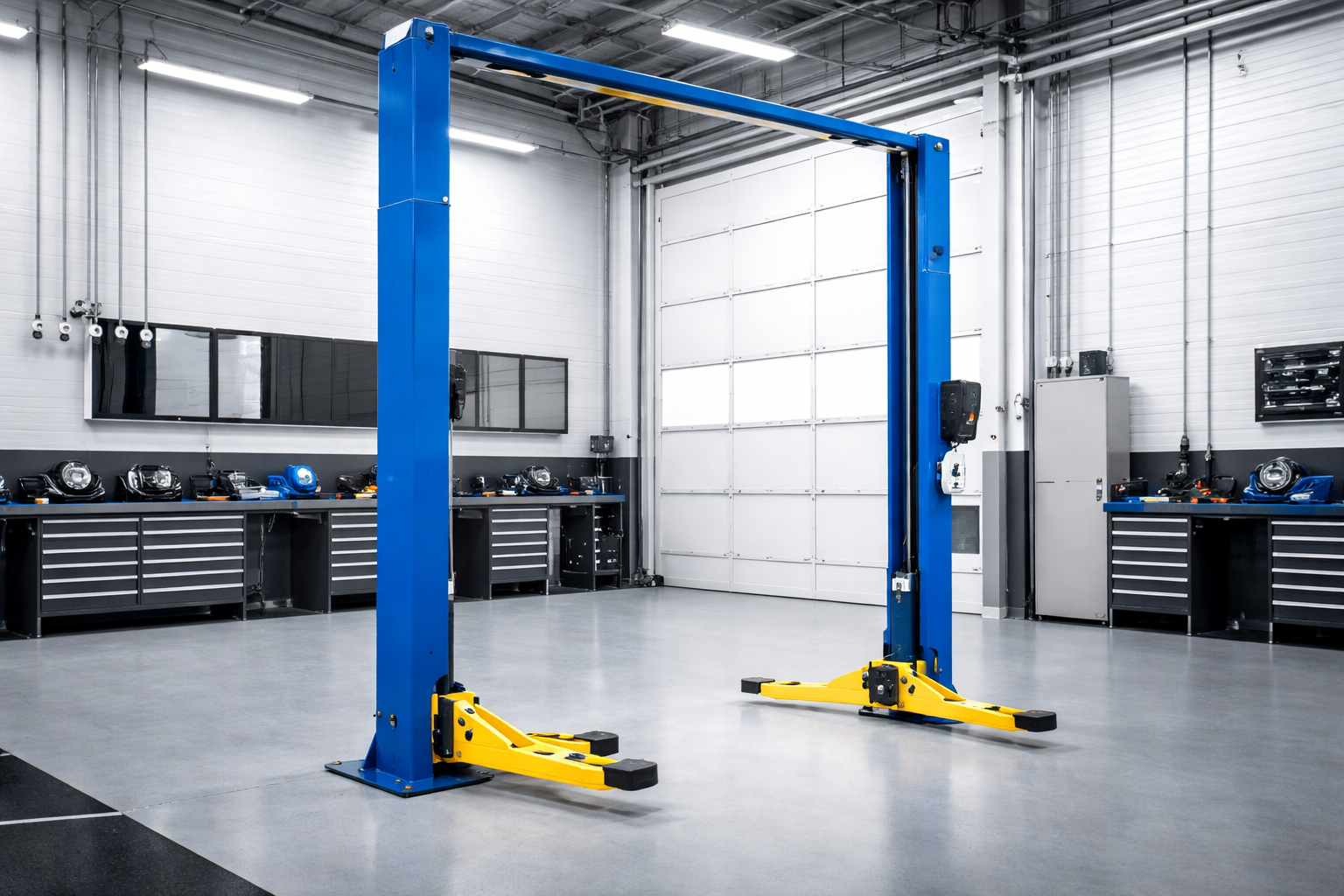
A 2 post car lift uses two vertical columns — one on each side of the vehicle — with swing arms that position under the vehicle’s factory lift points. The car is suspended in the air with the wheels hanging free.
This is the lift you’ll find in virtually every professional automotive repair shop in North America. The reason is practical: with the wheels hanging and the undercarriage fully exposed, mechanics can access every component — suspension, brakes, exhaust, transmission, drivetrain — without restriction.
2 post lifts come in two arm configurations:
- Symmetric arms — both columns have arms that extend equally front and back, best for commercial shop use
- Asymmetric arms — rear arms are longer, positioning the vehicle further back so the door can open without hitting the post
2. What Is a 4 Post Car Lift?
A 4 post car lift uses four vertical columns — two on each side — with runways or ramps that the vehicle drives onto. The tires rest on the runways, and the vehicle is lifted with all four wheels supported.
This design is fundamentally different from a 2 post lift in one critical way: the tires are load-bearing throughout the lift. That makes it excellent for storage but limits underbody access compared to a 2 post.
That said, many 4 post lifts can be paired with a rolling bridge jack that sits between the runways. This allows you to jack up individual axles for brake work or tire rotations — though it still doesn’t match the full access of a 2 post.
3. Key Differences at a Glance
| Feature | 2 Post Lift | 4 Post Lift |
|---|---|---|
| Underbody Access | Full (wheels hang free) | Limited (tires on runways) |
| Vehicle Storage | Not ideal | Excellent |
| Drive-On Loading | No (jack point only) | Yes |
| Floor Space | Less | More |
| Installation | Requires anchor bolts | Simpler setup |
| Price Range | $2,000 – $6,500+ | $2,500 – $8,000+ |
| Best For | Repairs, maintenance | Storage, alignment, detailing |
| ALI Certification | Available | Available |
| Ceiling Requirement | 11–14 ft typical | 10–12 ft typical |
4. 2 Post Lift: Advantages and Limitations
Advantages
- Complete, unrestricted underbody access
- Smaller footprint than 4 post lifts
- Faster vehicle loading
- Preferred by professional mechanics
- More affordable at similar capacities
- Industry standard
Limitations
- Requires precise positioning
- Not ideal for long-term storage
- Needs concrete anchoring
- Vehicle can’t be repositioned mid-air
5. 4 Post Lift: Advantages and Limitations
Advantages
- Easy drive-on design
- Ideal for vehicle storage
- More stable base
- Compatible with bridge jacks
- Some models don’t require anchoring
- Great for alignment and detailing
Limitations
- Limited underbody access
- Takes more floor space
- Requires ramp clearance
- Bridge jacks add cost
6. Which Lift Is Right for Your Situation?
| Your Primary Goal | Recommended Lift |
|---|---|
| Repairs & maintenance | 2 Post |
| Vehicle storage | 4 Post |
| Auto repair shop | 2 Post |
| Alignment work | 4 Post |
| Home garage work | 2 Post |
| Showroom display | 4 Post |
| Heavy trucks | 2 Post (high capacity) |
| Small garage | 2 Post |
7. Ceiling Height Requirements
Before buying, measure from floor to lowest obstruction.
2 Post Lift
- Minimum: ~11 ft
- Ideal: 12–14 ft
Low Ceiling Option
- Special lifts available for 9–10 ft garages
8. Concrete Requirements
2 Post Lift
- Minimum: 4 inches thick
- Recommended: 6 inches
- Strength: 3,000 PSI
- Fully cured concrete required
4 Post Lift
- Minimum: 4 inches
- Anchoring recommended for safety
9. Lift Capacity Guide
| Vehicle Type | Weight | Recommended Lift |
|---|---|---|
| Compact cars | 2,500–3,800 lbs | 8,000–9,000 lb |
| SUVs | 3,800–5,500 lbs | 9,000–10,000 lb |
| Pickup trucks | 4,500–6,000 lbs | 10,000–12,000 lb |
| Heavy-duty trucks | 6,500–8,500 lbs | 15,000–18,000 lb |
10. Symmetric vs Asymmetric Arms
Symmetric
- Balanced positioning
- Best for trucks
- Common in commercial shops
Asymmetric
- Better door access
- Ideal for home garages
- Preferred for cars & SUVs
11. Top Brands Compared
| Brand | Known For | Best Use |
|---|---|---|
| BendPak | Premium quality | Home & commercial |
| Rotary | Industry standard | Commercial |
| Challenger | OEM grade | Multi-bay shops |
| Atlas | Best value | Home garages |
| Weaver | Budget-friendly | Entry-level |
12. Price Breakdown
2 Post Lifts
- Entry level: $2,000 – $3,500
- Mid-range: $3,000 – $4,800
- Commercial: $4,500 – $6,500
- Heavy duty: $5,500 – $8,500+
4 Post Lifts
- Entry level: $2,500 – $4,000
- Mid-range: $4,000 – $6,500
- Commercial: $6,000 – $10,000+
13. Frequently Asked Questions
Can I use a 2 post lift without drilling?
No. Anchoring is required for safety.
Minimum concrete thickness?
At least 4 inches, 6 inches recommended for heavy lifts.
Is 4 post safer?
Both are safe if properly installed and certified.
Can I install in a home garage?
Yes, if ceiling height and concrete meet requirements.
Do 2 post lifts work for trucks?
Yes, with proper capacity rating.
Our Expert Verdict
If you’re buying a lift to work on vehicles, choose a 2 post lift. It offers full access, takes less space, and is faster to use.
If your goal is storage or display, go with a 4 post lift.
Always choose ALL-certified lifts — safety should never be compromised.
Ready to Find Your Lift?
Our experts are available Monday–Saturday, 8AM–6PM EST.
- Browse lifts
- Get a custom quote
- Compare models
Call: +1 270-240-4495
Technical SEO Notes
- Add Article Schema
- Add FAQ Schema
- Add Breadcrumb Schema
- Add Speakable Schema
Internal links: